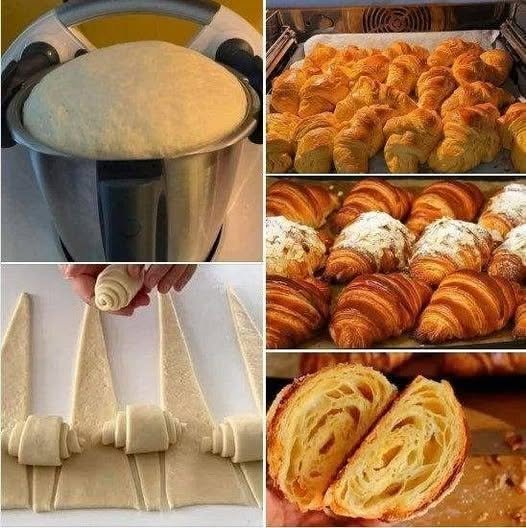

These classic Thermomix Croissants are buttery, golden, flaky, and wonderfully light inside, with crisp layers that make every bite irresistible. Made with a traditional yeast-based dough and a generous layer of butter, these homemade croissants use the classic lamination technique to create their signature flaky texture.
The Thermomix makes the mixing and kneading process much easier, but the most important part of making authentic croissants is still the folding and chilling. By carefully layering cold butter into the dough and giving it several folds, you create dozens of delicate layers that puff beautifully in the oven.
Whether you serve them for breakfast, brunch, afternoon tea, or a special weekend treat, these homemade croissants are well worth the extra time.
Why You’ll Love These Thermomix Croissants
- Buttery, flaky, and golden brown
- Light and airy on the inside
- Thermomix makes the dough preparation simple
- Made with basic baking ingredients
- Perfect for breakfast or brunch
- Can be prepared ahead of time
- Suitable for sweet or savory fillings
- Freezer-friendly
Recipe Overview
Preparation Time: 40 minutes
Resting & Chilling Time: 4–6 hours or overnight
Baking Time: 15–20 minutes
Total Time: Approximately 5–7 hours
Yield: 10–12 croissants
Ingredients
For the Dough
- 250 g all-purpose flour or bread flour
- 140 ml whole milk
- 40 g granulated sugar
- 5 g salt
- 10 g fresh yeast or 5 g instant/dry yeast
- 30 g unsalted butter, softened
Important: For classic croissants, use wheat-based flour. Almond flour is not a suitable substitute because it does not contain gluten and will not produce the stretchy, layered dough required for lamination.
For the Butter Block
- 150 g cold unsalted butter
For the best results, choose a good-quality butter with a high fat content, ideally around 82% or higher.
For the Egg Wash
- 1 large egg
- 1 tablespoon milk
How to Make Thermomix Croissants
Step 1: Activate the Yeast
Add the milk, sugar, and yeast to the Thermomix bowl.
Set the Thermomix to:
2 minutes / 37°C / speed 2
The mixture should be gently warmed and the yeast incorporated. Avoid overheating the milk, as excessive heat can damage the yeast.
Step 2: Make the Dough
Add the flour, salt, and softened butter to the Thermomix bowl.
Knead using:
3 minutes / Dough Mode
The dough should come together into a soft, smooth mixture. It may feel slightly sticky at first, but avoid adding too much extra flour because a firm dough can make the finished croissants dense.
Remove the dough from the bowl and shape it into a ball.
Place it in a lightly covered bowl or wrap it well. Refrigerate for 1–2 hours.
Chilling is important because cold dough is much easier to laminate and helps prevent the butter from melting into the dough.
Step 3: Prepare the Butter Block
Place the cold butter between two sheets of parchment paper.
Using a rolling pin, gently flatten and roll the butter into approximately a 15 x 15 cm square.
The butter should be:
- Cold
- Firm
- Flexible enough to roll
- Similar in consistency to the chilled dough
If the butter is too hard, it can crack during rolling. If it is too soft, it may melt into the dough.
Refrigerate the butter block until needed.
Step 4: First Lamination
Remove the chilled dough from the refrigerator.
Lightly flour your work surface and roll the dough into a rectangle approximately 20 x 30 cm.
Place the butter block in the center of the dough.
Fold the dough over the butter like an envelope, making sure the butter is completely enclosed. Press the seams gently to seal them.
Now roll the dough into a longer rectangle.
Fold it into thirds, just as you would fold a letter.
This is your first fold.
Wrap the dough and refrigerate for approximately 30 minutes.
Step 5: Repeat the Folds
Remove the chilled dough and rotate it so that the folded edge is positioned correctly for rolling.
Roll it into a rectangle again and fold it into thirds.
Refrigerate for another 30 minutes.
Repeat the rolling and folding process once more.
You will have completed three folds in total.
These folds are what create the many thin layers of dough and butter responsible for the flaky texture of classic croissants.
Important Lamination Tip
If the dough becomes soft, sticky, or difficult to handle at any point, stop rolling and place it back in the refrigerator.
Cold dough + cold butter = better layers.
Never force the dough when the butter starts becoming soft.
Step 6: Roll and Shape the Croissants
After the final chilling period, roll the dough into a large rectangle approximately 4 mm thick.
Trim the edges if necessary to create a neat rectangle.
Cut the dough into long triangles.
Each triangle should have a wide base and a pointed tip.
To shape each croissant:
- Make a small slit in the center of the wide end if desired.
- Gently stretch the triangle slightly.
- Starting from the wide end, roll the dough toward the pointed tip.
- Roll firmly but do not compress the layers.
- Place the croissant with the tip underneath so it does not unravel.
- Curve the ends slightly toward the center to create the traditional crescent shape.
Arrange the shaped croissants on a parchment-lined baking tray, leaving enough space between them for expansion.
Step 7: Proof the Croissants
Cover the croissants loosely and leave them at room temperature for approximately 1½–2 hours.
The exact proofing time depends on the temperature of your kitchen.
Properly proofed croissants should look noticeably larger, puffy, and slightly jiggly when the tray is gently moved.
Do not rush this step.
Under-proofed croissants can be dense and may not develop the beautiful honeycomb-like interior associated with well-made croissants.
Avoid placing them somewhere excessively hot because the butter can melt before the croissants reach the oven.
Step 8: Prepare the Egg Wash
In a small bowl, whisk together:
- 1 egg
- 1 tablespoon milk
Gently brush the egg wash over the tops of the proofed croissants.
Try to avoid brushing heavily over the cut edges, as excessive egg wash can interfere with the layers puffing properly.
Step 9: Bake
Preheat the oven to 200°C / 390°F.
Place the croissants in the preheated oven and bake for approximately 15–20 minutes, or until they are deeply golden brown and beautifully puffed.
Because ovens vary, begin checking them toward the end of the baking time.
Once baked, transfer the croissants to a wire rack and allow them to cool slightly before serving.
How to Get Perfectly Flaky Croissants
Keep Everything Cold
Temperature is one of the most important factors when making croissants. The butter should remain firm enough to form a distinct layer between the dough.
If the butter becomes too soft, it can blend into the dough instead of creating separate layers.
Don’t Skip the Chilling Periods
The refrigerator rests allow the dough to relax and the butter to firm up again. Skipping these rests can make the dough difficult to roll and reduce the flaky texture.
Don’t Overproof
Croissants need enough time to become light and airy, but overproofing can weaken their structure.
Look for croissants that are visibly puffy and slightly jiggly rather than relying only on the clock.
Use Good-Quality Butter
Butter is one of the main flavors in croissants, so high-quality unsalted butter makes a noticeable difference.
A butter with a high fat content is particularly helpful for lamination.
Don’t Add Too Much Flour
Use only enough flour to prevent sticking during rolling. Excess flour can make the dough dry and affect its texture.
What Do Properly Baked Croissants Look Like?
A successful croissant should have:
- A deep golden-brown exterior
- Crisp, flaky layers
- A light and airy interior
- Visible laminated layers
- A buttery aroma
- A delicate, slightly chewy crumb
When cut open, the interior should have an open, layered structure rather than looking like a dense piece of bread.
Make-Ahead Instructions
Croissant dough is ideal for preparing ahead of time.
After completing the dough and lamination, you can refrigerate the dough overnight. The longer, cool resting period can also help develop more flavor.
The following day, roll, cut, shape, proof, and bake the croissants.
This makes homemade croissants much easier to enjoy for a fresh breakfast.
Can You Freeze Croissants?
Yes. Croissants can be frozen either before or after baking.
Freezing Unbaked Croissants
Shape the croissants and place them on a tray.
Freeze until firm, then transfer them to a freezer-safe container or bag.
When ready to use, thaw them in the refrigerator or at room temperature as appropriate, then allow them to proof until puffy before applying the egg wash and baking.
Freezing Baked Croissants
Allow baked croissants to cool completely.
Wrap them well and freeze.
To serve, allow them to thaw and reheat in a preheated oven until warm and crisp again.
Croissant Filling Ideas
These croissants are delicious plain, but you can also add a filling before rolling.
Popular options include:
- Chocolate
- Almond cream
- Strawberry or raspberry jam
- Cheese
- Ham and cheese
- Hazelnut spread
- Cinnamon sugar
- Apple filling
Keep fillings relatively small so they do not prevent the croissants from sealing properly.
Serving Suggestions
Serve freshly baked croissants with:
- Butter and jam
- Honey
- Fresh berries
- Scrambled eggs
- Cheese
- Coffee
- Tea
- Hot chocolate
- Fresh fruit
They are especially delicious when served slightly warm from the oven.
Storage
Store baked croissants in an airtight container at room temperature for 1–2 days.
For the best texture, avoid refrigerating them unless necessary because refrigeration can make baked pastries lose their crispness more quickly.
To refresh them, place them in a 180°C / 350°F oven for approximately 5 minutes.
Allow them to cool slightly before serving.
Frequently Asked Questions
Why are my croissants not flaky?
The most common cause is butter that became too warm during lamination. When the butter melts into the dough, the distinct layers are lost.
Keep the dough and butter chilled and refrigerate the dough whenever it becomes too soft.
Can I use dry yeast instead of fresh yeast?
Yes. You can use approximately 5 g of dry yeast instead of 10 g of fresh yeast.
Follow the yeast manufacturer’s instructions if your particular yeast requires activation.
Why didn’t my croissants rise?
There are several possible reasons, including inactive yeast, insufficient proofing time, or a dough that was too cold during proofing.
Allow the croissants enough time to become visibly puffy and slightly jiggly.
Can I make croissants overnight?
Yes. One of the easiest approaches is to complete the dough and lamination, refrigerate the dough overnight, then shape, proof, and bake the next day.
How do I know when croissants are properly proofed?
Properly proofed croissants should look noticeably larger, airy, and puffy. They should also have a slight jiggle when the tray is gently moved.
If they are under-proofed, they may bake up dense. If they are significantly over-proofed, they may lose structure.
Why is butter leaking out during baking?
Butter leakage can happen when the butter became too soft during lamination, the layers were damaged, or the dough was not chilled sufficiently.
Make sure the butter stays enclosed and chill the dough whenever necessary.
Can I use whole wheat flour?
You can replace part of the white flour with whole wheat flour, but the croissants may be heavier and less flaky.
For a lighter texture, try using approximately 50% whole wheat flour and 50% white flour rather than replacing all of the flour.
Why are my croissants dense inside?
Dense croissants are often caused by insufficient proofing, damaged butter layers, excessive handling, or incorrect lamination.
Proper proofing and temperature control are especially important.
Do I really need three folds?
Three folds help create the many layers of dough and butter that give traditional croissants their characteristic flaky texture.
What is the best butter for croissants?
Use high-quality unsalted butter with a high fat content, ideally around 82% or higher.
Can I make croissants without a Thermomix?
Absolutely. The Thermomix mainly simplifies the mixing and kneading stage.
The dough can also be mixed by hand or kneaded using a stand mixer. The lamination, shaping, proofing, and baking processes remain essentially the same.
Nutrition Information
Approximate nutrition per croissant will vary depending on the exact ingredients and final size.
Estimated per croissant:
- Calories: 230–260 kcal
- Carbohydrates: 25–28 g
- Protein: 4–5 g
- Fat: 12–15 g
- Sugar: 5–7 g
- Fiber: Approximately 1 g
Final Tips for the Best Thermomix Croissants
For the best homemade croissants, remember these key points:
- Use wheat-based flour rather than almond flour.
- Keep the butter cold but pliable.
- Chill the dough between every fold.
- Roll gently to avoid breaking the butter layers.
- Don’t add excessive flour while rolling.
- Give the croissants enough time to proof.
- Bake only once the oven is fully preheated.
- Allow the finished croissants to cool slightly before serving.